


Quick-Build Materials & Webinars
“Quick-Build” materials are cost efficient and readily available materials such as paint, cones, barriers and signage, that a city can use to create safe lanes on streets for people who walk, bike and roll.
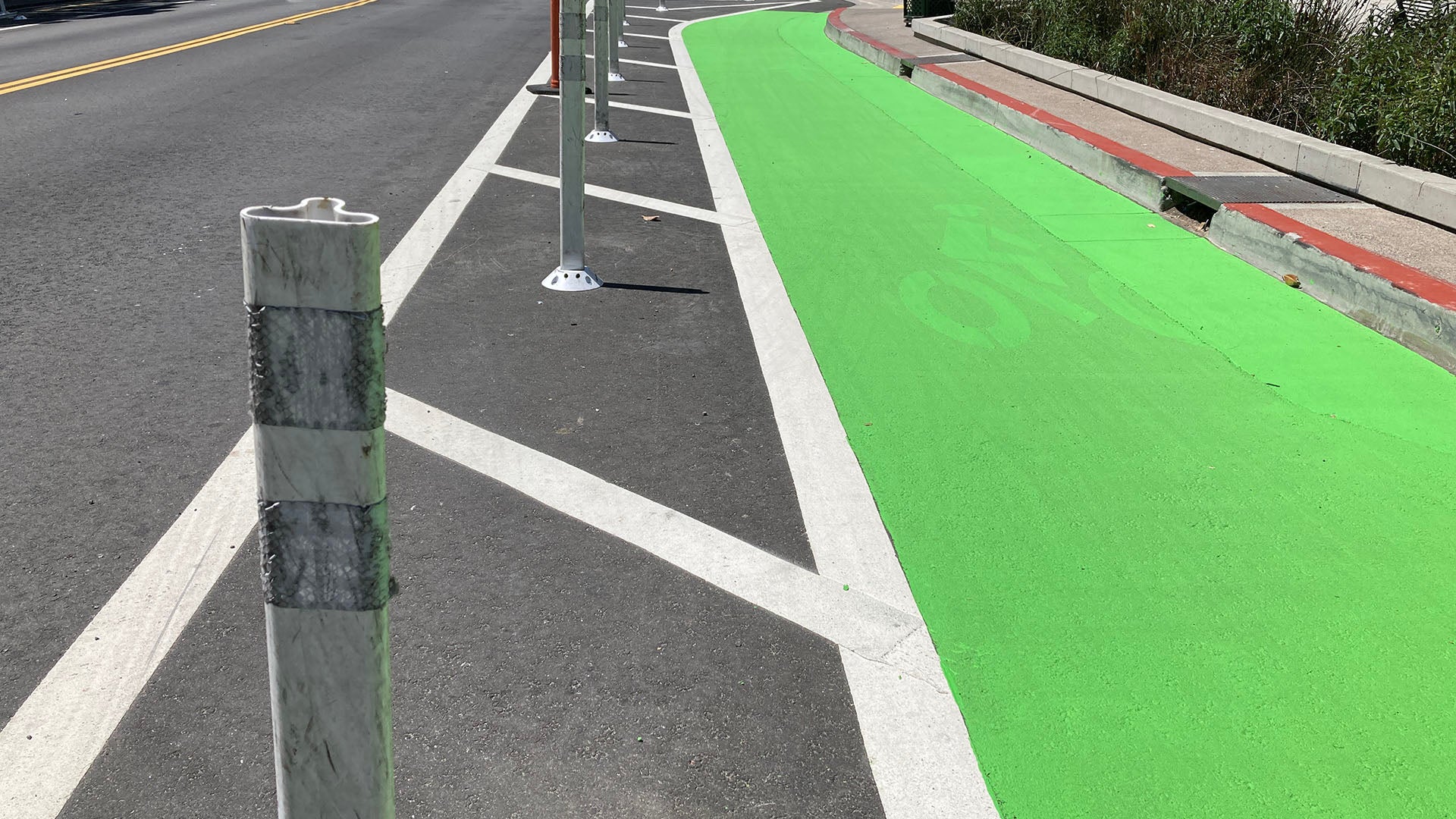
“Quick-build” materials allow cities and counties to quickly create safe lanes of traffic for people who are travelling by bike, by foot, by wheelchair, scooter or similar non-vehicle mode.
Giving people safe, active transportation options helps to cut down on vehicle pollution.
A Toolkit of Materials
See MTC’s toolkit of intervention objects and materials that cities in the Bay Area have been using to create physical and spatial boundaries, creating safer spaces for people using the street, including:
- Temporary Points: Colorful traffic cones, flexible bollards, painted points, plastic drum bollards, K-71 bollards, social distance painted points
- Permanent Points: Planter boxes, Armadillo lane separators, metal bollards
- Temporary Lines: Colorful crowd barriers, a-frame signage barriers, jute tubes, type III barriers, social distance line segments
- Permanent Lines: Playful seating, playful fencing, complete streets spacial configurations
- Temporary Planes: Plastic K-Rails/Jersey barriers, barricade covers, haystacks, painted streets, social distance spherical planes
- Permanent Planes: Painted K-Rails, seating and landscape edges, parklets
The Benefits of Quick-Build Materials
Cities and counties can implement complete-street improvements using temporary, light, cost efficient and readily available “quick-build” materials such as paint, cones, barriers and signage.
Unlike long-term capital improvement projects, quick-build implementation timelines are shorter and may include demonstration projects (days to months), pilot projects (months-years) and interim design (1-2 years).
Design testing, flexibility and prototyping are built into the quick-build process so that the improvements are iterative in nature, adjustable and can accommodate community needs.
Staff Contacts
Toshi Shepard-Ohta
Phone: 415-778-5280
Email: tshepard-ohta@bayareametro.gov
Quick-Build for Complete Streets Webinar Series
In this webinar series, learn how you can ramp-up Complete Street redesigns for your community, with pedestrian and bicycle facilities and protected intersections.
Webinar Details & Materials
Quick-Build Projects for Small Towns, Rural and Suburban Contexts
March 10, 2021 - Tony Garcia, Street Plans Collaborative
Over the past decade the Quick-Build method has been used by small towns, suburbs and rural areas to accelerate infrastructure improvements at an increasingly large scale.
Join MTC for a conversation with Tony Garcia from Street Plans Collaborative, one of the leading Quick-Build practitioners, to discuss how Quick-Build projects have been implemented in small towns, suburban and rural contexts in California and beyond.
Learn how projects have been implemented in collaboration with State agencies, and how the project types and applications change based on the surrounding land use context.
Hardening Slow Streets: From Pilot to Permanent during COVID-19
December 14, 2020 - Jessica Zdeb, Jeremy Chrzan, and Gwen Shaw, Toole Design Group
Join Jessica Zdeb, Jeremy Chrzan and Gwen Shaw from Toole Design Group to learn more about how to transition successful COVID-era street redesigns to pilot, interim, and permanent projects. We will discuss recommended processes, practices, designs, materials, and outreach strategies to ensure these transitions work for residents, the general public, and implementing agencies.
Adapting Streets During Uncertain Times: Using Quick-Build to Create Resilient Streets and Public Spaces
April 7, 2020 - Tony Garcia, Street Plans Collaborative
Cities around the world are recognizing the need to adapt to ever-changing conditions during the quarantine and beyond. Many are learning that this moment is presenting both a need and an opportunity to expand the space they allocate for bicyclists and pedestrians.
Join MTC for a webinar with Street Plans Collaborative Founder Tony Garcia for a conversation about how cities can use the Quick-Build methodology to address critical street safety and neighborhood improvement projects.
Rebalancing Streets for People
April 8, 2020 - Gwen Shaw and Jeremy Chrzan, Toole Design Group
Discussion with Gwen Shaw and Jeremy Chrzan of Toole Design Group. Communities around the world are adapting to a new normal. One unanticipated dilemma is how to enable people to walk, bike, and run outside while still social distancing.
Popular parks and trails are filled with people exercising, getting some fresh air, and taking care of their mental health. Sidewalks and bike lanes are at capacity as essential workers walk, ride, and scoot instead of taking transit.
At the same time, many streets are eerily empty of cars. The pressure is on to re-balance our streets, at least temporarily, to provide more safe places for people to walk, bike, and run while maintaining a safe physical distance from each other. How do we make this transformation happen?
Quick-Build During a Crisis: Constructing Projects Rapidly for Social Distancing, Planning for Social Cohesion
April 9, 2020 - Vignesh Swaminathan, Crossroad Lab
Discussion with Vignesh Swaminathan of Crossroad Lab. Urban Vibrancy Matters. We see it now more than ever during a time of social distancing.
These unprecedented times affect us drastically. 2019 was the year of Urban Mobility and Active Transportation, but as 2020 comes around we are hit with the hard reality of COVID-19. But that does not mean we should lose momentum—if anything, the community is itching to get outside. Cities around the world have been collaborating to develop Quick-Build and Active Transportation projects.
Over the past few years, we’ve had the private sector, politicians, and communities all begging for rapid implementation. The need to quickly respond to community, traffic, paving, and equity issues—and now a shelter-in-place order—presents an opportunity to continue developing these types of projects.
Below are some of the sources of funding for quick-build projects:
- COVID-19 Rapid Response Bicycle and Pedestrian Grant Program
- Active Transportation Program - Cycle 5 Quick-Build Pilot
- NACTO City Grants for Pandemic Response and Recovery
- PeopleForBikes Community Grant Program
- AARP Community Challenge
- Build a Better Barrier Challenge
- Arts & Transportation Rapid Response
Below are some additional quick-build resources:
AARP
Alta Planning + Design
Alta Planning + Design & California Bicycle Coalition
City of Fayetteville, AR
City of Fort Worth, TX
Massachusetts Department of Transportation
Minnesota Department of Transportation
Mobycon
National Association of City Transportation Officials (NACTO)
- COVID-19: Transportation Response Center
- Rapid Response: Emerging Practices for Cities
- Streets for Pandemic Response and Recovery
- Urban Street Design Guide
- Blueprint for Autonomous Urbanism
- Global Street Design Guide
- Urban Bikeway Design Guide
- Transit Street Design Guide
- Urban Street Stormwater Guide
- Bike Share Station Siting Guide
- Designing for All Ages & Abilities
- Don't Give Up at the Intersection
PeopleforBikes
Safe Routes Partnership
San Francisco Planning Department
The Street Plans Collaborative
- COVID19 Livable Streets Response Strategies
- Tactical Urbanism. Vol. 1 – 6
- Open Streets Project
- Tactical Urbanist’s Guide to Materials and Design
- Fast-Tracked. A Tactical Transit Study
- Asphalt Art Guide